
It has been several months since the release of the Southeast Gateway Reconnecting Communities Planning Study results. If you haven’t read the Report or need a refresher, read it here.
The Report presents a vision for the Southeast Gateway while also helping us imagine what could be possible for the rest of the I-65/I-70 downtown Inner Loop. Its 18 attachments provide the facts, data, demographics, financial analysis, community input, and examples from across the country that make a compelling case for capping the interstate at the Southeast Gateway—and for using future infrastructure investments to reconnect neighborhoods and unlock opportunities for urban transformation elsewhere along the Inner Loop.
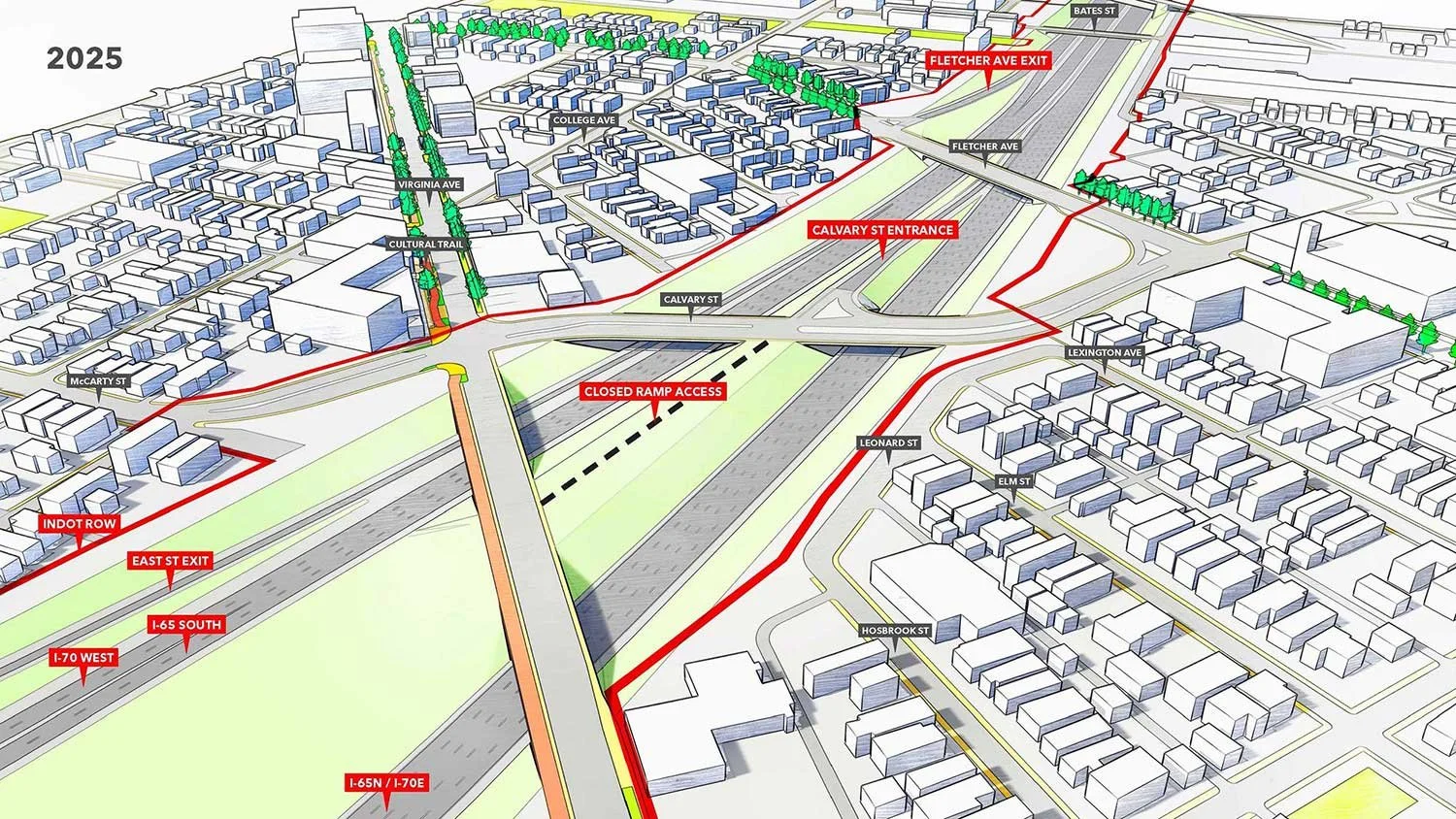
A rendering of Cap Concept #3 from the Indianapolis I-65/I-70 Southeast Gateway Planning Study Report.
Looking West
With a detailed analysis of what’s possible at the Southeast Gateway complete, we are now focused on West Street, the fourth leg of the interstate Inner Loop that was never built, and its I-65/I-70 connections to the north, near Crispus Attucks and IU Health’s new campus, and south, near Lucas Oil Stadium, Elanco, and the Lilly Research Center.
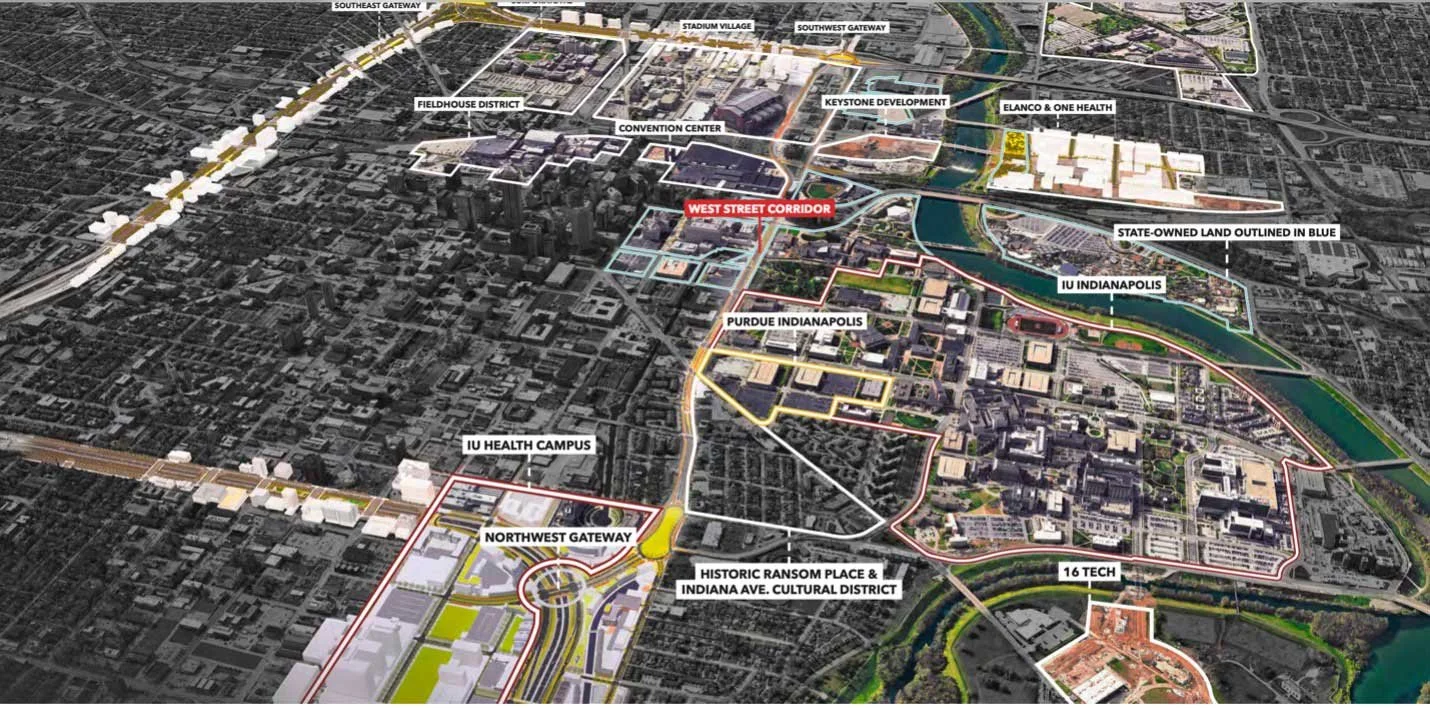
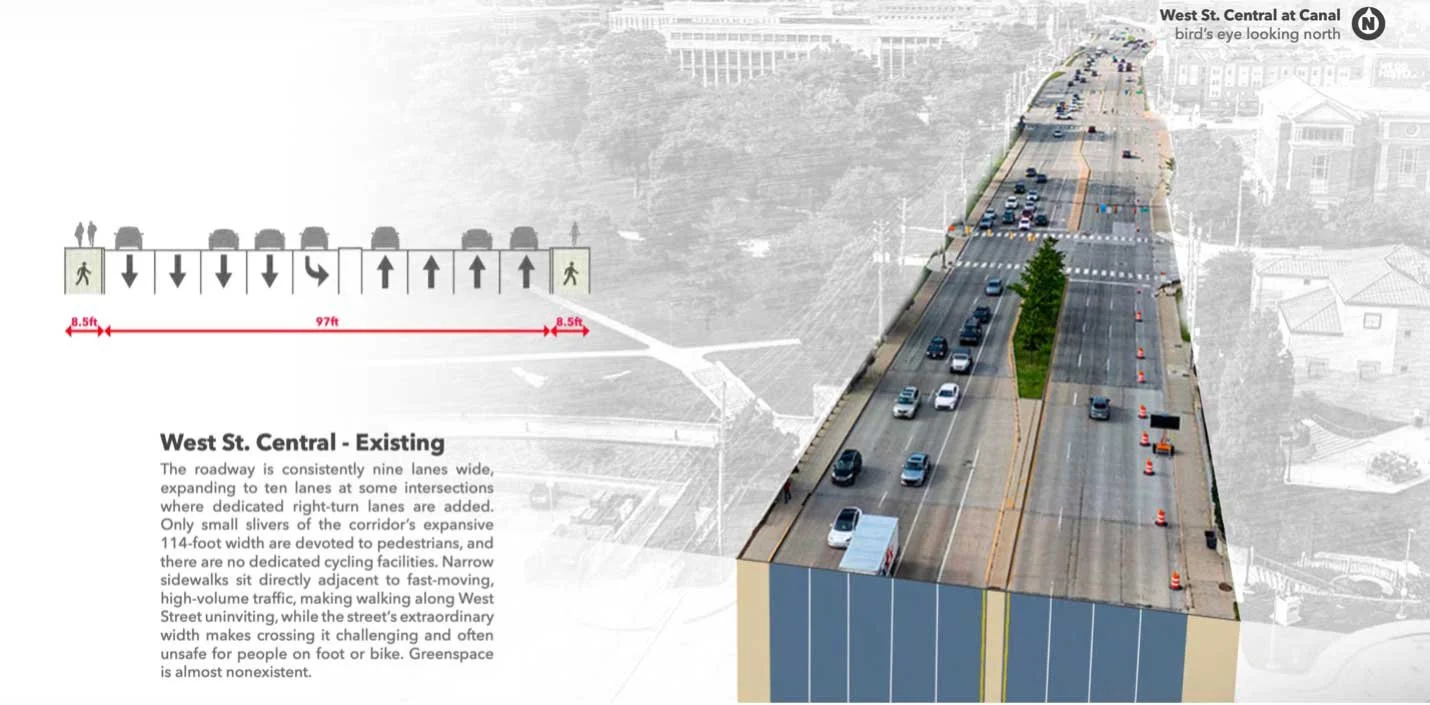
With its multiple lanes, sparse trees, and unprotected sidewalks, West Street acts as a significant barrier between an extraordinary array of life and health sciences, university, sports and tourism, neighborhood, State, and convention center assets.
Imagine the catalytic impact of linking these assets into a cohesive corridor, with a redesigned West Street and the I-65/I-70 downtown interstates forming a corridor “spine” extending toward the Southeast Gateway. A connected corridor could help fuel Indiana’s next wave of growth and give us a competitive advantage on a national scale.
The focus on West Street aligns with INDOT’s priority first to rebuild the I-65 north leg of the Inner Loop near IU Health’s new campus at the northern terminus of West Street. INDOT will then its attention to the I-70 leg near Lucas Oil Stadium at the southern end of West Street. As a first step, Rethink Coalition is working in partnership with the Indy Chamber and the City of Indianapolis to complete a high-level economic analysis and transportation study that will help us understand what’s possible for the corridor. Once that work is complete, we’ll begin working closely with neighbors and stakeholders to develop a comprehensive vision and plan.
In short, the assets along this corridor represent a concentration of institutions, talent, investment, and opportunity that is nationally distinctive. State and City government, world-class universities and hospitals, life and animal health leaders, major employers, sports and convention destinations, museums and cultural institutions, neighborhoods, nonprofits, and development opportunities—it’s all here, concentrated within a remarkably small geography. Few competitor cities can match what we already have. The opportunity is to connect these assets in a way that allows the whole to become far greater than the sum of its parts.
It’s time to put away our Midwest Modesty and think boldly about what this corridor could become—not simply for downtown Indianapolis, but for Indiana. Decisions about the Inner Loop and West Street will shape this part of our city for the next half-century or more. We have a once-in-two-generations opportunity to align major infrastructure investment with economic development, talent attraction, quality of life, and community connectivity—and to create a corridor that helps drive Indiana’s future. We cannot afford to miss it.
We're not alone:
The Highway Teardown Tour
We recently came across a fascinating podcast series from the team at WGBH Boston Public Radio that created The Big Dig podcast. (If you haven’t listened to the original series, we highly recommend it).
The new Highway Teardown Tour travels to cities across the country that are wrestling with the same questions we’re asking in Indianapolis: What do we do with urban interstates built 75 years ago that divided neighborhoods, created barriers, and reshaped our downtowns? And what becomes possible when cities rethink, redesign, remove, or reconnect across those highways.
The series takes listeners to Seattle, New York City, Syracuse, Rochester, Austin, Portland, Louisville, Baltimore, Philadelphia, and other communities, with interviews featuring people directly involved in efforts to reimagine urban highways and reconnect their cities.
It’s informative, thought-provoking, and especially relevant to the work happening here. Indianapolis is not alone. Cities across the country are confronting the legacy of urban interstates—and thinking boldly about what comes next.
Listen to The Big Dig and the Highway Teardown Tour at WGBH Boston, or search for The Big Dig wherever you get your podcasts. The Highway Teardown Tour is Episodes 10–19.
And listen to the original, in case you missed it: The Big Dig Podcast
$63 Million Invested. $3 Billion in added property value.
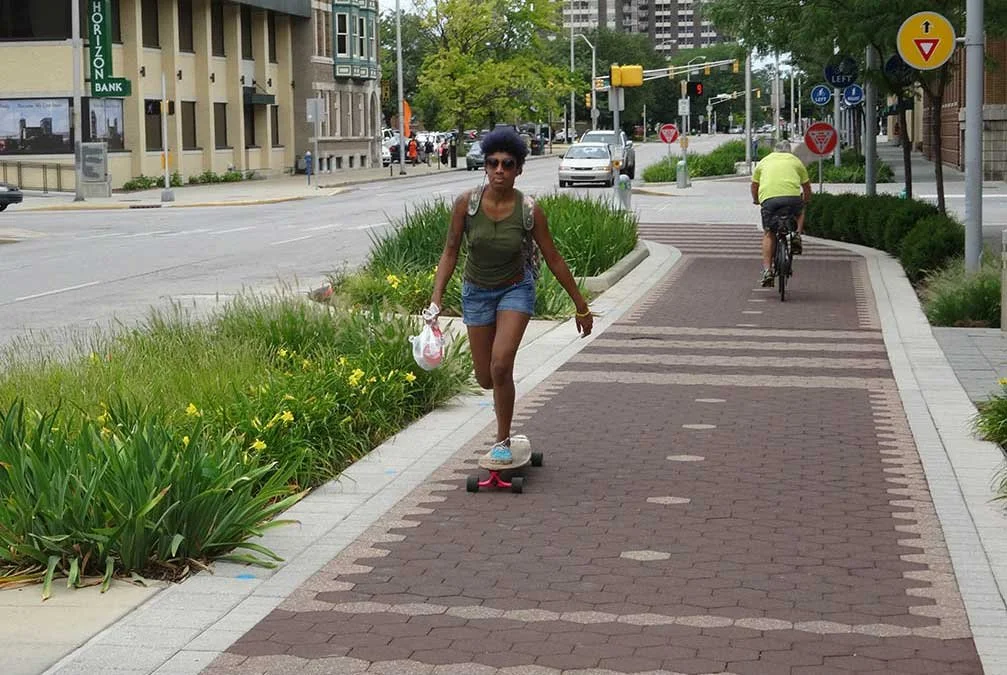
A skateboarder and cyclist travel the Indianapolis Cultural Trail as it winds through the Mass Ave Cultural Arts District.
A recent Indianapolis Business Journal article highlights the extraordinary impact of one of Indianapolis’s most transformative infrastructure investments: the Indianapolis Cultural Trail.
According to a new economic impact study, property along the Cultural Trail has experienced $3 billion in added assessed value since work on the trail began in 2007—following an initial public and private investment of just $63 million. The study also found that retail space along the trail has increased 39%, food and beverage sales per square foot are nearly double the citywide average, and population along the trail has grown at five times the city average.
For Rethink, there’s an important lesson here. Infrastructure shapes what happens around it. Thoughtful investments in connectivity, public space, placemaking, and quality of life can catalyze private investment and economic growth far beyond the initial public investment. As Indy Chamber CEO Matt Mindrum told IBJ, the Cultural Trail demonstrates “the power of placemaking at work.”
As Indianapolis considers the future of the downtown Inner Loop and West Street, the Cultural Trail offers a powerful example close to home of what can happen when we think about infrastructure not simply as a way to move people through a place, but as an investment in the place itself.