Rethink Coalition's 1st Submission to the INDOT CSS Process
The Rethink Coalition has developed a collective response to INDOT’s request for input on suggested CSS concepts, ideas and treatments for the North Split project.
Read that collective response here.
Battle Over Inner Loop Must Shift to New Phase
Our downtown interstate system is approaching the end of its life span. Since its installation 50 years ago, the inner loop has divided our capital city and displaced more than 17,000 residents. Now, it will be reconstructed in stages, starting with the north split. What will replace it?
Over the past 18 months, a group of residents, businesses and civic organizations known as the Rethink 65/70 Coalition has raised concerns about the issue. The group’s tireless efforts and meetings with Indiana Department of Transportation representatives, state legislators, the Mayor’s Office, the City-County Council and community leaders have led to three important outcomes:
INDOT has made improvements to its original plan by reducing the size of the north split interchange, greatly reducing the number and height of retaining walls, and eliminating additional through lanes. INDOT deserves credit for listening and adapting.
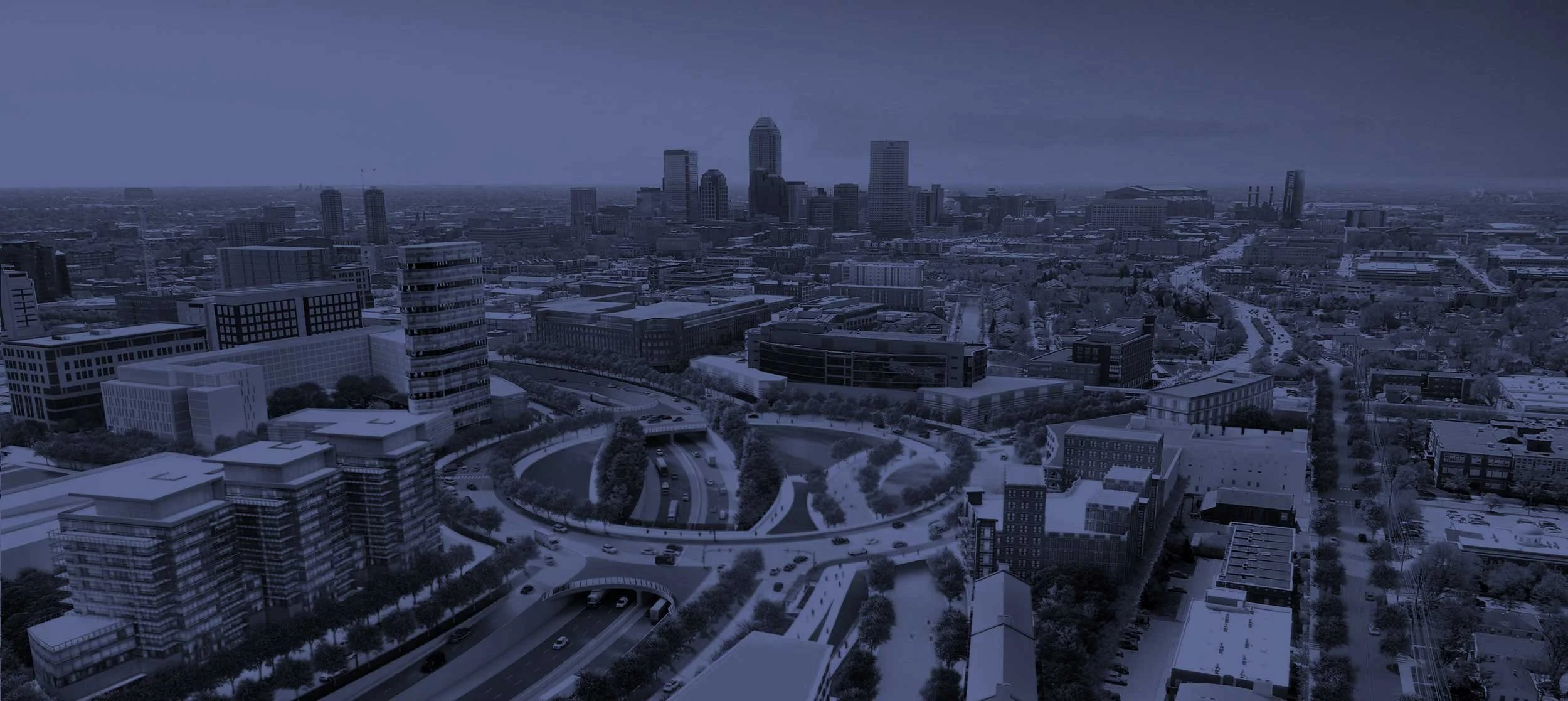
The Rethink coalition, meanwhile, has developed a vision for reconstructing the remainder of the inner loop as a recessed highway to shrink its footprint, reconnect streets, heal old community wounds, and provide new land for development. Peer cities—such as Cincinnati, Dallas and Denver—are adopting similar innovations.
Most critically, the coalition’s efforts have revealed an unsettling flaw in planning: No single, agency is responsible for looking at the full picture and taking advantage of the massive opportunity this reconstruction project presents for our city and state.
This third point deserves examination. INDOT’s role is building roads and moving traffic. The city believes the interstate is the state’s concern. And the Metropolitan Planning Organization is more focused on our eight-county region than on the Indianapolis core.
While other states have been addressing the decay of their urban highways with innovation, we have been allowing opportunity to slip through the cracks. Had better planning and coordination taken place five years ago, the current north-split design could have been entirely recessed—increasing connectivity and creating the framework for new economic development today, not 10 years from now.
Going forward, the Rethink coalition will shift focus from debating with INDOT about the north split and concentrate instead on the following:
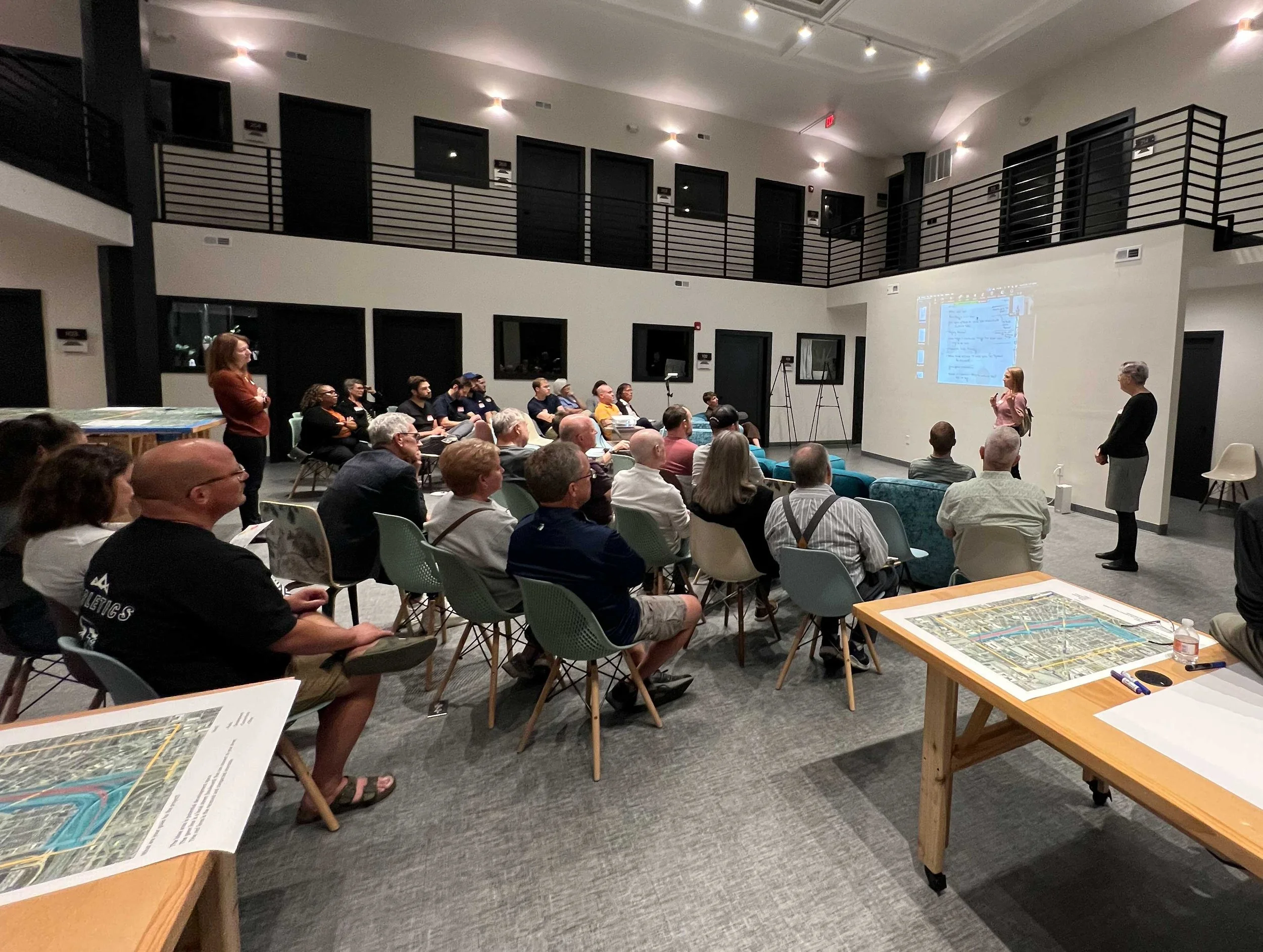
Engaging in INDOT’s Context Sensitive Solutions process to help integrate the north-split design into the fabric of our urban communities.
Pushing for comprehensive planning for reconstruction of the inner loop—starting with studies that give appropriate consideration to the recessed highway concept.
To begin, we’re calling for two important studies: one comparing the cost of a recessed reconstructed inner loop to an elevated reconstructed inner loop, and a second comparing the impact of each approach on downtown traffic.
These studies can be completed in a few months at a tiny fraction of what will likely be a $2 billion inner-loop reconstruction. This small investment will get the facts on the table as we work to create infrastructure improvements with the potential to launch decades of economic growth and a beautiful, multi-functional, connected urban core that can be the envy of our competitor cities.
Acting now can make this city and state leaders in urban design. Delay will only have us playing catch-up, again.
The choice is ours: Move boldly and rapidly to take the Crossroads of America to the next level or sit complacently and watch opportunity pass us by.
An Update to Supporters on Rethink 65/70
Over the last two months the Rethink 65/70 Coalition Leaders have been busy conducting a series of meetings and presentations with business leaders, business associations, civic leaders, city-county councilors, state legislators, the staffs of our federal Senators and Congressman, as well as representatives of our state government. We continue to educate and explain the enormous benefits of the Recessed Highway Reconstruction concept we developed for the downtown Inner Loop with the help of the economic impact analysis conducted by Arup Advisors, Inc.
In virtually every meeting and presentation, people come away excited about the potential to turn a necessary highway reconstruction project into a transformative public asset, reconnecting our urban core and serving as a catalyst for economic development for the next five decades.
The Crossroads of America is at its own crossroads. We can either rebuild highways based on outdated thinking, or we can use 21st century innovations to prioritize economic development and quality of life.
The State is moving forward with its design to reconstruct the North Split, where I-65 and I-70 come together at the northeast corner of the downtown Inner Loop. The Rethink Coalition agrees that many of the bridges in the “Spaghetti Bowl” are near the end of their expected useful life and need to be replaced. We don’t object to replacing the interchange. Our concern is that the reconstructed North Split not prohibit the future connection to a recessed highway on the north and east legs of the Inner Loop.
Our study of the State’s Alternative 4c design leads us to believe that the State’s current design does indeed prohibit the reasonable connection to a recessed highway in the future. Thus, we are asking the State to change its design at the west and south transition points of Alternative 4c to reasonably accommodate a future recessed highway connecting to the North Split on the north and east legs of the Inner Loop.
Obviously, we believe the recessed highway approach to reconstructing the downtown Inner Loop holds tremendous value to the city and state for decades to come. But we are not asking the State to commit to a recessed highway at this time. We are simply asking that that option not be eliminated by the design and construction of the current North Split project.
We have the chance to transform the core of our Capital City for the next generation and truly compete with peer cities for the best companies, jobs, and talented people. We cannot let the current North Split design prohibit the best Inner Loop reconstruction for the future.
The leadership team still has more interesting and important meetings and presentations coming up in the next few weeks. We should know by then whether reason can prevail, and the North Split project can accommodate a future recessed highway design for the Inner Loop. If not, we will be back to you and it will be time to dial up our voices to Rebuild it Right.
Rethink Coalition Invites Public to Hear Experts’ View of Redesign Opportunities
The Rethink 65/70 Coalition will host a presentation at Indiana Landmarks Center on Nov. 12, where national experts will reveal the findings of a study evaluating INDOT’s downtown interstate analysis and the potential for economic development that the interstate reconstruction could harness. The event is free and open to the public.
The Coalition hired Arup Advisors, an internationally renowned consulting company specializing in large infrastructure projects, to conduct a review of INDOT’s latest preliminary preferred alternative 4c against the Coalition’s 4 Principles, and assess the possible economic development opportunities that exist along the interstate within INDOT’s current right of way.
The Coalition developed four guiding principles: 1) no lane expansion; 2) no above-grade walls outside of the North Split, 3) enhance economic development; 4) increase connectivity between downtown and surrounding neighborhoods on the north, east and south legs of I-65 and I-70. INDOT’s new plan for the North Split meets one of the principles in having no large walls. But it calls for interstate widening in some areas. And it falls short on addressing enhanced economic development and greater connectivity for neighborhoods near the interstate.
Arup will discuss its findings at a meeting on Nov. 12 at 6 p.m. (doors open at 5:30 p.m.) at Indiana Landmarks Center, 1201 Central Avenue. The Coalition invited INDOT and representatives from local and state government agencies to preview the findings earlier that same day.
“The Arup Study has confirmed that there are significant economic development opportunities along the interstate in downtown Indianapolis,” said Marsh Davis, president of Indiana Landmarks and a member of the Rethink 65/70 Coalition. “Their projections suggest that there could be up to 10 million square feet of residential and office development along the interstate, with approximately 3,000 new residential units and over 22,000 jobs.”
“Arup is an acclaimed international firm with deep experience in transportation design. We hope Arup’s findings will help shape INDOT’s present work on the North Split and provide positive direction for future interstate redesign on the east and south legs of the downtown highway,” Davis adds.
Congestion Concerns Shouldn’t Drive Inner Loop Fix
MAY 18 2018 | TOM GALLAGHER | INDIANAPOLIS BUSINESS JOURNAL | POSTED WITH PERMISSION
I must confess my disappointment in the system-level analysis the Indiana Department of Transportation recently released for the controversial downtown Inner Loop project. I had hoped INDOT would embrace what we’ve learned from 70 years of experience with limited-access highways and help us arrive at solutions that position us for the 21st century. It is not entirely clear to me what the ultimate answer should be, but I know the opportunity deserves more scrutiny. Here are a few broad topics worth considering:
Congestion
There is no such thing as “zero congestion.” We cannot completely rid ourselves of traffic delays during peak drive times, but it is certainly fair to consider a course of action when congestion becomes severe. On the opening page of the Inner Loop project website, INDOT states that the north split is “one of Indiana’s most congested interchanges.” While this might be the case, the Indianapolis metro area is one of the least congested in North America.
In global navigation company TomTom’s worldwide traffic congestion index, Indy ranks third-best among nearly 200 cities with populations of at least 800,000. The index says Indy drivers experience about 15 minutes of delay per day (about eight minutes during each peak). Though not as plainly stated, the numbers in INDOT’s analysis appear to suggest the same.
Adding lanes does not solve congestion. It is true that there might be a short period of improvement immediately after a road is widened, but the improvement itself soon leads to more congestion. The less-congested road draws more drivers until capacity is exceeded again.
The Katy Freeway in Houston claimed the title of world’s widest highway, weighing in at 26 lanes, when it was built for $2.8 billion in 2011 to counter growing congestion in the region. By 2014, the Katy was experiencing more congestion than it had in 2011 by 30 percent in the morning and 55 percent in the afternoon.
Economic success and traffic volumes are not proportionally related. According to the Federal Bureau of Economic Analysis, the Indy metro area, from 2001 to 2015, experienced an increase in population of 300,000 people, improved total employment by more than 15 percent, and saw gross domestic product rise 70 percent. The TomTom Traffic Index indicates the level of congestion has remained essentially unchanged over a similar period.
Drivers are pliable. Traditional traffic models have a hard time accounting for human resourcefulness. In other cities where urban freeways have been decommissioned, drivers have effectively taken advantage of alternative routes. We need to recognize that the whole urban network of roads works together as a system. If the urban grid of streets is allowed to function at its best, few things are more efficient.
Consider the 2004 Purdue study of the Hyperfix Project, a weeks-long shutdown of the downtown interstate in 2003 that allowed for repaving and other modifications. During Hyperfix, most surface roads saw an increase in vehicles, but delays were “observed to be relatively minor,” the worst of which ranged from “24 seconds to 195 seconds.” The study states, “Commuters felt that the project did not significantly affect travel into the downtown area. Because alternate routes were available, the majority of riders took them.”
Land Value
The diminished value of real estate adjacent to a highway is permanent. Our historic urban neighborhoods have come a long way in 50 years, mitigating the negative effects of the Inner Loop. The reality, however, is that, while the highway exists, the adjoining properties will not increase in value at the same rate as similar ones blocks away. In contrast, a different kind of infrastructure can instigate higher adjacent values, like the 22 percent premium seen in Chicago along the 606 Trail or the improvement in property values along the Cultural Trail here in Indy.
Equity
Highways, by their nature, are inequitable. There is a simple graphic under the Environmental Justice tab of INDOT’s North Split website that illustrates how the same resources, used conscientiously, can provide greater opportunity for all. Yet, highways, by design, must be exclusionary. Biking and walking are prohibited, and one must be able to afford a car to take part in the benefits.
One thing we can be sure of, given the state of the aging infrastructure and the inadequacies of its original design, we will need to spend significantly on whatever comes next. In spite of the cost, this should be seen as an opportunity.
Since the Inner Loop was completed five decades ago, phones have gone from rotary to having more computing capacity than NASA had for the Apollo missions. Surely our transportation leaders can find a way forward that matches mobility with our changed populace, optimism for urban living and desire for social justice.
Don't Squander Opportunity to Rethink I-65/I-70 Project in Indy Downtown
The Rethink 65/70 Coalition strongly believes that investment in the I-65/I-70 North Split and downtown interstate expansion will reshape the economy and quality-of-life in Indianapolis for the next 50 years - either positively or negatively. Let’s work together to find a positive rather than negative outcome.
BRIAN PAYNE | INDIANAPOLIS BUSINESS JOURNAL | POSTED WITH PERMISSION
The Rethink 65/70 Coalition strongly believes that investment in the I-65/I-70 North Split and downtown interstate expansion will reshape the economy and quality-of-life in Indianapolis for the next 50 years - either positively or negatively. Let’s work together to find a positive rather than negative outcome.
INDOT recently unveiled a System Level Analysis of seven alternative concepts for reconstruction of the downtown I-65/I-70 Inner Loop that evaluated traffic patterns, cost of construction and timing. However, INDOT’s process does not include evaluation of larger economic or quality-of-life impacts of reconstructing the interstates through downtown, which happens to be the State’s largest economic engine.
Current INDOT plans for Interstate 65/70 Inner Loop “mobility and expansion improvements” will not fully resolve congestion or address environmental, social justice, economic development and quality of life issues created by that system 40+ years ago.
Commissioner McGuinness’s recent opinion article indicates INDOT will move forward with a North Split rebuild which entails a complete tear-down and rebuilding an expanded version of the North Split. It will extend added lanes and build-out to existing right-of-way replacing existing landscaped banks with imposing vertical walls. The North Split rebuild is the template for future expansion east, west and south; creating a walled city for future generations.
We owe future generations a better approach to the growth and mobility needs of the region and the city. Our Coalition proposes real change: from a dysfunctional system that will increasingly wall in the city center and wall out its nearby neighborhoods, to a transformative system that recreates urban connectivity, development potential and revenues and the open space needs of a growing and competitive city of the 21st Century.
Our growing Coalition is defining a new vision for this critical infrastructure that joins a national movement that is repurposing aging urban interstates, just like ours, in ways that revitalize cities while still accommodating commuters and growing logistics traffic.
Our vision recalls the spirit of Colonel Eli Lilly and other civic leaders in the early 1900’s to rethink the city’s form, structure and condition which was then limiting growth and prosperity, resulting in the Historic Park and Boulevard System. It recalls the vision that embraced and continues to restore the White River that forms the central geography of the region. It also recalls the highly successful vision of the Indianapolis Cultural Trail: a Legacy of Gene and Marilyn Glick that has spurred an unimaginable repopulating of the downtown with new generations of citizens that have embraced the concept of a walkable, bikeable and connected city.
Our vision is simple. Prioritize people, while accommodating cars and other transportation modes in a balanced way. INDOT’s current direction has that backwards. Economic development in dense urban areas in the 21st century is based on people. Human capital. Not interstate expansion that induces traffic and grows congestion.
The Coalition seeks a comprehensive, community-wide, independent plan that evaluates the impact of traffic, as well as larger quality-of-life effects such as economic development, urban planning, neighborhood revitalization, walkability, bicycle friendly, green space and beauty. There are ways to do that and there are creative ways to fund it. Pausing this project for sixteen weeks to develop an alternative plan will not jeopardize federal funding. Available maintenance strategies can address immediate safety concerns.
We need to seize this opportunity and are ready to lead the effort in a transparent process. The Coalition urges residents, businesses and community leaders to contact the Governor’s Office, State Legislators and the Mayor’s Office to support an independent comprehensive plan for moving highway traffic into and through our Capital City, in a way that creates opportunities to equitably grow our economy and quality of life over the next 50 years. Why would a state, region and city of responsive leaders do otherwise?
Payne is president and CEO of the Central Indiana Community Foundation, which is a member of the Rethink 65/70 coalition.
What You Need to Know About the I-65/I-70 North Split Controversy
The half-century-old highway system spidering through north Downtown Indianapolis is about to either be rebuilt in accordance with today's standards, or re-imagined as a new way to move traffic through the city.
MARCH 16 2018 | AMY BARTNER | INDYSTAR | POSTED WITH PERMISSION
The half-century-old highway system spidering through north Downtown Indianapolis is about to either be rebuilt in accordance with today's standards, or re-imagined as a new way to move traffic through the city.
Last week, a coalition formed to demand the Indiana Department of Transportation radically rethink how I-65 and I-70 cross through Downtown, either to move the split underground or eliminate it altogether. It's a move that will impact the city's neighborhood connectivity for the next 50 years, and leaders of the coalition, Rethink 65/70, want to exhaust all options before rebuilding.